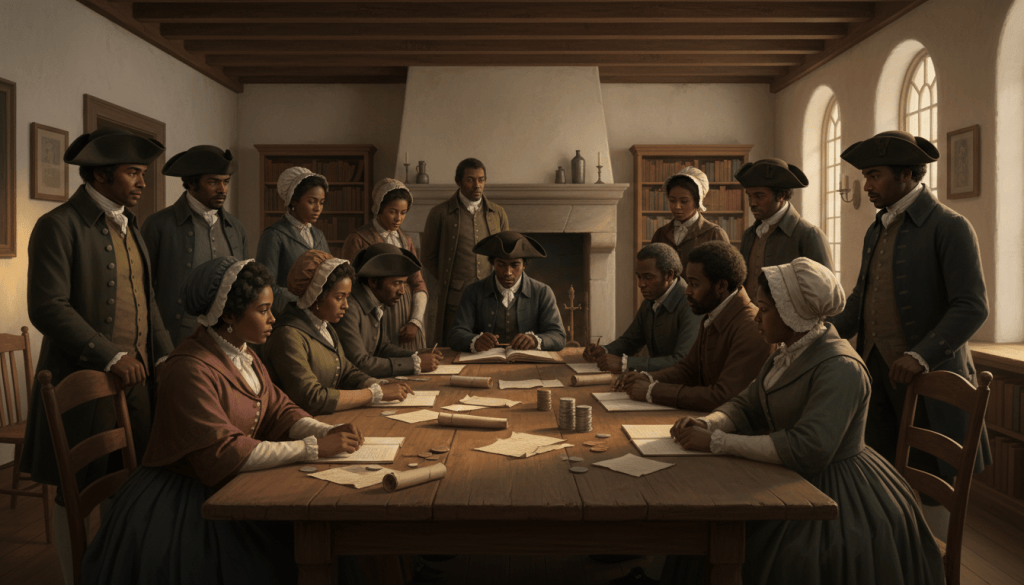
What happens when a community knows what it needs, but the institutions around it are not built to meet those needs?
In 1787, free Black Philadelphians responded to that question with something more durable than a slogan. They organized regular contributions, wrote rules, chose officers, and established a system to support families facing sickness, death, or hardship. The organization was the Free African Society, founded with leadership from Richard Allen and Absalom Jones.
The lesson is not that a community can overcome every structural injustice through self-help alone. It is that a commitment to self-determination becomes tangible when people create an institution with obligations, records, and accountability.
An Institution Before a Slogan
On April 12, 1787, Allen and Jones helped organize a nondenominational mutual-aid society in Philadelphia. Both men had experienced enslavement and became prominent organizers in the city’s free Black community. Their association welcomed people across religious denominations, subject to rules about conduct and contributions.
The society’s articles, preserved in a transcription made available by the National Park Service, specified a contribution of one shilling per month in Pennsylvania currency. After a year of contributions, qualifying members in need could receive three shillings and nine pence per week, subject to the rules. The association also addressed support for widows and children, school fees when free schooling was unavailable, and apprenticeships to help young people learn trades.
These amounts are historical details, not a template for a modern savings or insurance plan. The more important fact is the design: who contributed, who could receive help, who handled funds, and what procedures governed the organization were written down.
Its membership rules also imposed strict behavioral standards. That aspect deserves scrutiny. Respectability requirements could exclude people who were already vulnerable, and the society operated within the gender and religious assumptions of its time. The institution’s ingenuity should not require us to adopt every rule or moral judgment it made.
Mutual Aid Is a System, Not Merely a Feeling
According to historian Elise Kammerer’s account in the Encyclopedia of Greater Philadelphia, the society offered assistance with burial costs, family hardship, education, apprenticeships, illness, and unemployment. The Smithsonian’s National Museum of American History places such organizations within a broader pattern: by 1800, free Black communities had established churches and mutual-aid societies in several American cities.
This was not the invention of all mutual aid. Communities in Africa and across the diaspora had many forms of reciprocal support long before 1787. What makes this particular society especially useful for historical study is that we can examine its surviving rules and documented activities rather than relying on a generalized story of solidarity.
A community can believe deeply in unity while lacking any agreed method for managing shared resources. The Free African Society shows what changes when principles become administration.
1793: The Institution Meets a Crisis
In 1793, Philadelphia suffered a devastating yellow fever epidemic. Members of the Free African Society provided nursing, burial assistance, and other care to residents across racial lines. This work mattered when many people were frightened, ill, or leaving the city.
It also exposed a dangerous medical misconception. Physician Benjamin Rush and others believed that people of African descent were unusually resistant to yellow fever. That was false. Black Philadelphians became sick and died as well. The National Park Service’s account of the city’s response documents both the assistance offered by the society and the losses experienced by Black residents.
The distinction matters. We can recognize courageous service without romanticizing the suffering of those who performed it. A mistaken racial theory helped shape expectations about who should take risks. The community’s contribution did not make that theory true.
After the epidemic, printer Mathew Carey circulated allegations about Black caregivers. In 1794, Allen and Jones published A Narrative of the Proceedings of the Black People, During the Late Awful Calamity in Philadelphia to challenge the accusations and defend the community’s conduct. The Library of Congress preserves a copy.
This reveals two related forms of institution-building: mutual aid, which addresses an immediate need, and independent documentation, which preserves an account of what happened. The society served people; its leaders also defended the public record. The later story of Freedom’s Journal belongs to the same broad tradition of Black self-representation, but this earlier episode has its own distinct significance.
What the Source Text Teaches, and What the Evidence Establishes
The accessible The Original Man / Born Power material in the Melanated Elevation research library emphasizes knowledge of self, shared resources, education, community ownership, and the construction of independent institutions. It treats the application of knowledge as more important than simply possessing information.
As philosophy, that raises a useful question: what happens when knowledge of a community’s needs becomes organized responsibility? The Free African Society is a compelling case through which to investigate the question.
As historical evidence, the founding rules, the society’s documented relief activities, and the surviving 1794 pamphlet support a narrower conclusion: this specific Black-led association established a functioning mutual-aid arrangement and helped shape early Black institutional life in Philadelphia. That record does not establish any universal racial doctrine, claims of biological superiority, or the proposition that pooling resources can eliminate systemic inequality by itself.
The available Born Power materials also refer to Wisdom teachings and the 120 Lessons. A complete, independently identifiable Wisdom_120 text was not available for line-by-line verification in this research. This article likewise does not claim to have read full editions of When the World Was Black or Science of Self for this installment. Their broader themes can prompt questions, but primary documents and reputable historical scholarship are used to answer factual ones.
That separation protects the integrity of the inquiry. A source may inspire a question without being the final authority on its answer.
The Limits of Self-Help Belong in the Story
The Free African Society did not operate in a fair or equal society. Its members faced a world still shaped by enslavement, racial exclusion, economic insecurity, and unequal rights. Mutual aid could reduce certain harms; it could not undo the structures that produced them. Historical self-reliance should not become an argument that institutions or governments have no responsibility to address injustice.
The society also experienced internal disagreements. Religious and organizational differences contributed to its decline as a unified association, while Allen and Jones became associated with distinct Black churches. These institutions helped sustain community life after the original association weakened. The Encyclopedia of Greater Philadelphia reports that more than one hundred mutual-aid societies operated in the Philadelphia region by 1838. That later growth reflects a larger associational history, not a simple story in which one organization single-handedly caused every successor.
A strong institution is not one in which disagreement never happens. It is one in which responsibility can continue despite changing leadership and priorities.
The Emerging Builder’s Application
You do not have to launch a cooperative or financial institution tomorrow. Start by distinguishing a shared aspiration from a working system.
- Name one specific problem. Tutoring, transportation, emergency meals, access to tools, career mentoring, or preserving local history are more actionable starting points than a promise to solve every community problem.
- Write down the responsibilities. Who contributes time or money? Who is eligible? Who decides? What records are kept? What happens when a commitment is not met?
- Design for inclusion. A system that excludes the people who most need support may reproduce the vulnerability it was intended to address. Consider differences in income, time, disability, and caregiving responsibilities.
- Make accountability routine. Keep clear records, report outcomes, handle conflicts of interest, and create a way to challenge decisions. Consult appropriate legal and financial professionals before collecting or managing pooled funds.
- Preserve the record. Document what was promised, what was delivered, what failed, and what changed. Future generations need evidence they can examine, not only stories they are asked to believe.
The practical question is not simply whether a community values ownership or unity. It is whether the people involved can explain what they built, how it works, whom it serves, and how it can be corrected.
What Will You Build That Someone Else Can Verify?
The Free African Society did not wait for ideal conditions. Its members organized contributions, offered assistance, faced a public crisis, and defended their own record. That is not a myth about invulnerability. It is a documented example of people building capacity under difficult circumstances.
What is one need in your community that could be addressed by a small, transparent, repeatable system rather than another conversation about what should happen?
Begin with that question. Study the evidence. Invite the people affected into the design. Build something modest enough to operate and accountable enough to improve.
Continue the Work
Explore the Melanated Elevation Journal, mission, apparel, and current resources at melanatedelevation.com. The purpose is to turn awareness into disciplined action, ownership, and a legacy that can be examined rather than merely claimed.
Sources & Further Reading
- National Park Service, Preamble and Articles of Association for the Free African Society. Transcription of the 1787 articles reproduced from William Douglass’s 1862 history. The transcription includes an acknowledged date typo; the correct year is 1787.
- Elise Kammerer, Free African Society, Encyclopedia of Greater Philadelphia. Historical synthesis of membership, relief activities, disagreements, and institutional legacy.
- National Park Service, A City Response to Yellow Fever. Historical context for the 1793 epidemic and the role of Black Philadelphians.
- Richard Allen and Absalom Jones, A Narrative of the Proceedings of the Black People (1794), Library of Congress. Primary document.
- Historical Society of Pennsylvania, The Yellow Fever Epidemic. Historical context for the mistaken immunity belief and public dispute.
- Smithsonian National Museum of American History, Free African American Communities. Wider context for early Black mutual-aid organizations.
- The Original Man / Born Power, accessible Melanated Elevation project copy. Used as a philosophical lens, not as independent historical verification.
Editorial note: The accompanying images are contemporary historical reconstructions, not archival photographs or depictions of identifiable historical individuals.

