Historical Black Knowledge Research Series
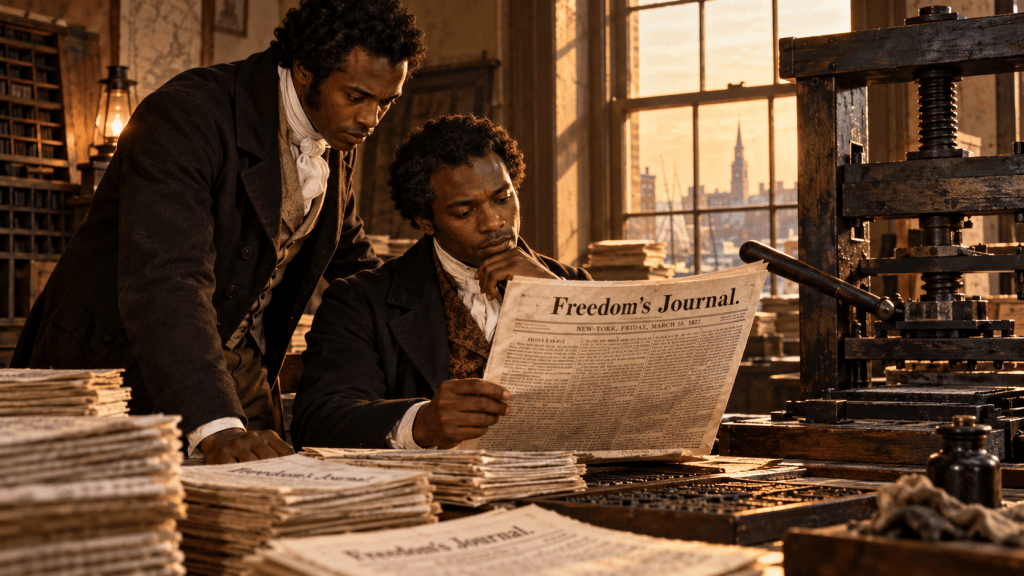
In 1827, nearly four decades before the end of legal slavery in the United States, two Black editors in New York made a decision that still matters in the age of algorithms: if other institutions were going to describe Black people to the world, Black people also needed institutions capable of documenting themselves.
“We wish to plead our own cause. Too long have others spoken for us.”
Samuel E. Cornish and John B. Russwurm, Freedom’s Journal, 1827
That sentence is often remembered as a declaration of representation. It was also an argument about infrastructure. Freedom’s Journal was not simply asking for better treatment in somebody else’s newspaper. Its founders built a newspaper.
What Freedom’s Journal Actually Was
The Library of Congress identifies Freedom’s Journal as the first newspaper published by Black Americans in the United States. It began in New York City on March 16, 1827, under editors Samuel E. Cornish and John B. Russwurm, and ran until 1829. The paper covered regional, national, and international news while addressing slavery, colonization, education, employment, housing, births, marriages, deaths, business, and other matters affecting Black communities.
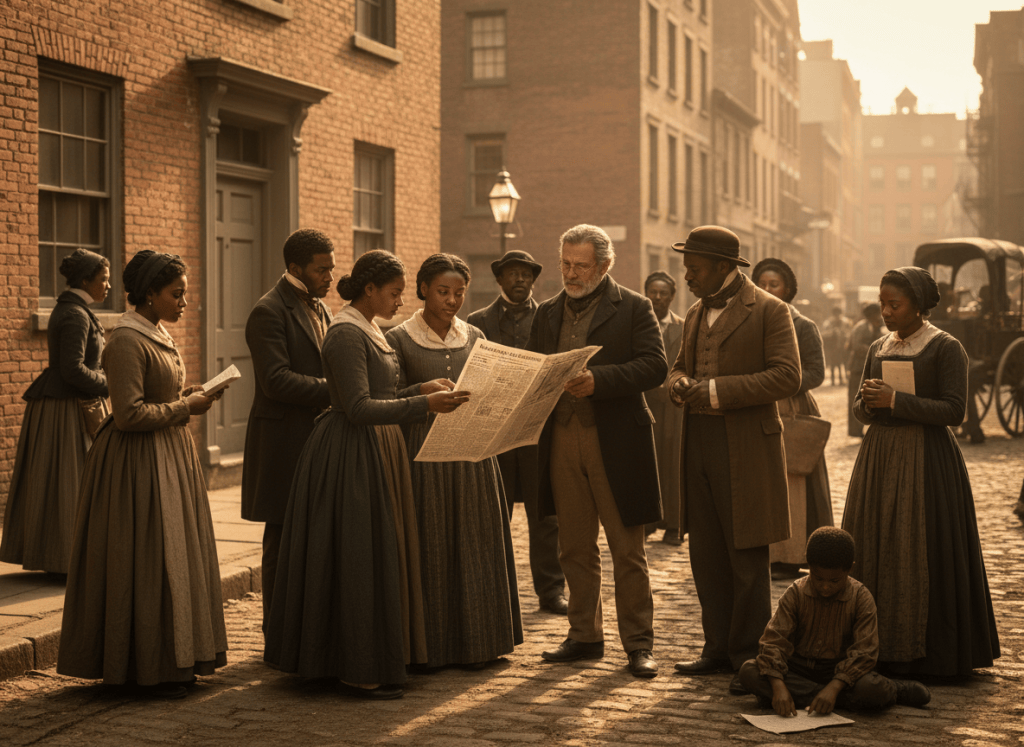
This matters because the Black press was doing more than responding to racism. It was recording ordinary Black life, circulating useful information, debating political questions, preserving memory, and creating a channel through which Black people could appear as thinking, working, organizing human beings rather than as objects in somebody else’s story.
The Source Lens: Knowledge of Self and the Power to Define
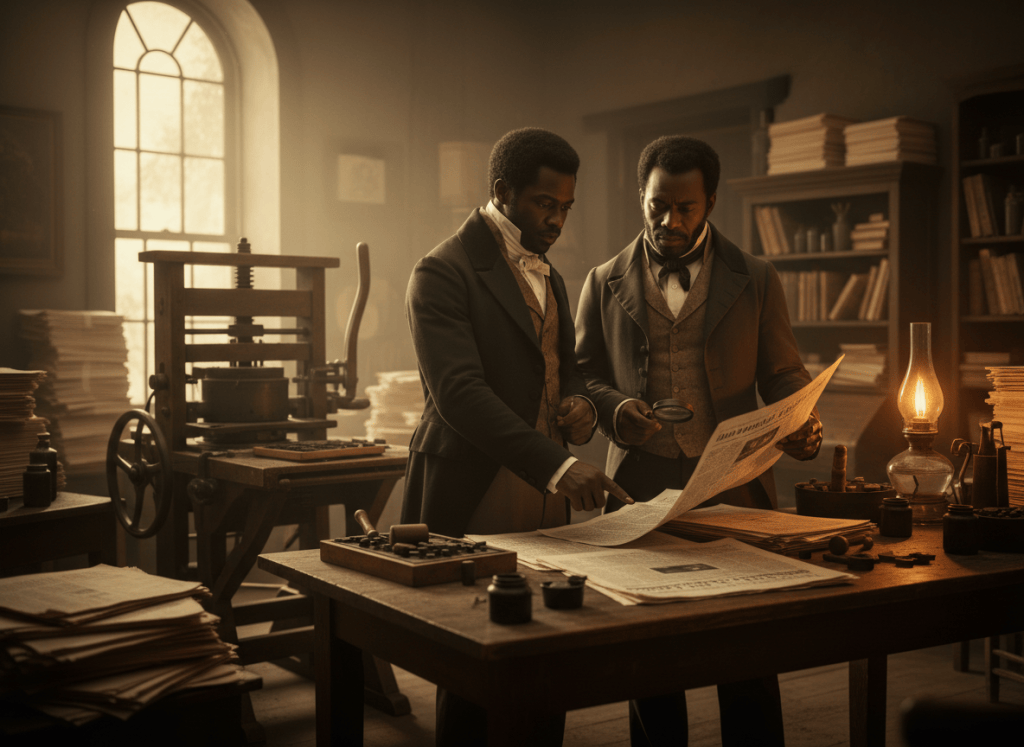
Some of the source texts used in the Melanated Elevation research library, including The Original Man and Wisdom_120, repeatedly frame knowledge of self as a defense against being defined, governed, or intellectually limited by others. The Original Man also connects self-determination to ownership of institutions such as media, education, land, and technology. Wisdom_120 presents knowledge as something that should be made useful rather than merely possessed.
That is the philosophical lens, not the historical proof. These texts contain religious, symbolic, ideological, and historical claims of very different evidentiary quality. Some claims in this literature, including racial-biological doctrines, mythic chronologies, and claims about ancient peoples that conflict with established scholarship, should not be treated as empirical history simply because they carry cultural meaning.
The responsible question is therefore not, “Does history prove every teaching in the source text?” It does not. The better question is: Where does a useful philosophical principle intersect with evidence we can independently verify?
With Freedom’s Journal, that intersection is unusually clear. The proposition that a people benefit from the capacity to document themselves is not dependent on a mythic chronology or racial doctrine. We can examine the newspaper itself, its editors, its surviving issues, its subjects, and the institutions that followed it.
What the Historical Evidence Supports
Three conclusions are well supported.
1. Black Americans deliberately built media institutions to counter misrepresentation.
The founding editorial is explicit. Cornish and Russwurm complained that Black people had been misrepresented in the press and argued for the ability to speak on matters that concerned them directly. This was not retrospective symbolism placed onto the newspaper by modern readers. It was part of the editors’ stated purpose.
2. Narrative ownership included practical information.
Freedom’s Journal did not operate only as protest literature. Library of Congress materials document its attention to community information, social issues, education, business and everyday life. That makes “owning the narrative” more concrete. A community information system can help people know what is happening, where opportunities exist, what institutions are available, what debates are unfolding, and how a community understands itself.
3. Black-owned media did not mean one unified Black viewpoint.
This point is essential. Russwurm’s own politics changed. He initially opposed the American Colonization Society’s program of relocating free Black Americans to Africa, later supported colonization, and emigrated to Liberia in 1829. Cornish opposed that shift and continued his own publishing work. Black ownership created the capacity for Black voices to enter the public record; it did not eliminate disagreement among Black people.
That distinction protects historical study from becoming mythology. A Black institution can be historically important without every position it publishes becoming correct. Representation and verification are separate responsibilities.
What We Should Not Claim
Freedom’s Journal does not prove that Black-controlled information is automatically accurate. It does not prove that cultural alignment guarantees truth. It does not validate unrelated racial-biological or ancient-history claims found in later ideological literature. And it should not be romanticized as though the nineteenth-century Black community held one worldview.
What the record demonstrates is narrower and stronger: Black Americans recognized a problem of representation and responded by building an institution through which they could publish information, arguments, community life, and their own interpretations of events.
From Freedom’s Journal to the Modern Information Environment
In 1827 the barrier was access to the printing press and public representation. In 2026 almost anyone with a phone can publish. The modern problem is therefore different. We have more Black voices, more independent creators, more archives, more podcasts, and more direct access to audiences, but also an information environment in which attention, speed, recommendation systems, clipped context, and viral incentives can reward claims before they are verified.
That changes the responsibility without eliminating it.
Self-representation still matters. So does evidence. A claim does not become reliable because it makes us feel powerful, confirms what we already believe, comes from a Black creator, attacks a source we distrust, or uses the language of “hidden knowledge.” The same intellectual independence that asks us to question outside narratives should also give us permission to question narratives produced inside our own communities.

The Emerging Builder’s Lesson: Build a Knowledge Infrastructure
For the Emerging Builder, the lesson of Freedom’s Journal is bigger than “control your narrative.” A narrative without infrastructure is fragile.
- Preserve. Keep books, interviews, family records, photographs, documents, and credible digital archives instead of allowing your historical memory to live entirely on a social feed.
- Verify. Separate primary evidence, established scholarship, interpretation, philosophy, and speculation. They can all be worth examining, but they are not interchangeable.
- Publish. Document useful knowledge. A community that produces no record leaves future generations dependent on records produced about it.
- Own. Build websites, publications, archives, businesses, educational resources, and other channels that cannot be reduced to temporary visibility on someone else’s platform.
- Correct. Intellectual ownership includes the ability to say, “We got this wrong.” Correction strengthens a knowledge system; it does not weaken it.
This is where knowledge of self becomes disciplined action. Knowing who you are should not require inventing a past. It should increase your capacity to study the past carefully, recognize what your predecessors actually built, understand where they disagreed, preserve what is useful, correct what evidence does not support, and build institutions capable of carrying knowledge forward.
The Question to Carry Forward
If our ancestors understood the importance of building their own information infrastructure in 1827, what are we building now that future generations will be able to study, verify, inherit, and improve?
That is a more demanding version of knowledge of self. It asks not only what you know about yourself, but what you are preserving, producing, owning, and leaving behind.
Continue the Work
Explore the Melanated Elevation Knowledge of Self Library, a free curated reading and study guide organized around ROOTS, SELF, BODY, and BUILD, with critical-thinking prompts, verification guidance, and a structured reading path.
Sources & Further Reading
- Library of Congress, Freedom’s Journal (New-York [N.Y.]) 1827–1829.
- Library of Congress Research Guides, “Press & Publishing: African Americans in Business and Entrepreneurship.”
- Library of Congress, “Free Blacks in the Antebellum Period: The Free African American Press.”
- Library of Congress, Chronicling America, “The Rights of All and The Freedom’s Journal.”
- Smithsonian National Portrait Gallery, “John Russwurm.”
- The Original Man: 30 Books in One, accessible Melanated Elevation project copy. Used as a philosophical/source-text lens; factual conclusions above were independently checked against historical sources.
- Wisdom_120, accessible Melanated Elevation project copy. Used as a philosophical/source-text lens, not as independent empirical authority.
Historical Black Knowledge is a Melanated Elevation research series examining historical and philosophical source traditions alongside independently verifiable evidence. The goal is neither dismissal nor uncritical repetition, but disciplined study.

