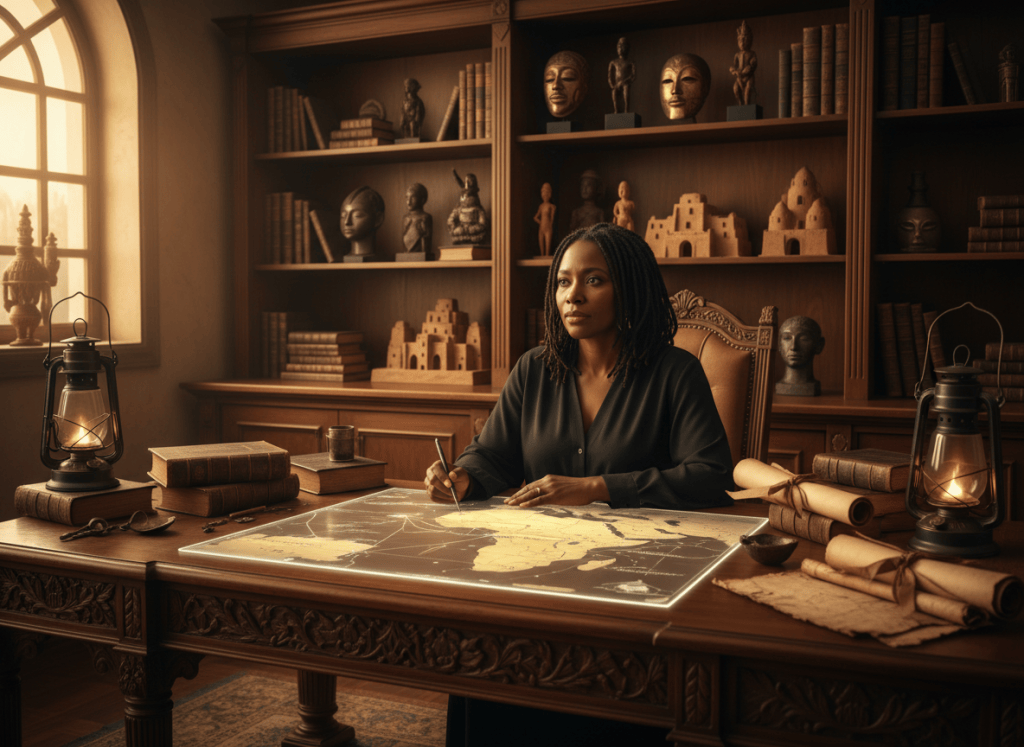
What changes when you learn the history that existed before enslavement?
For many Black Americans, the most familiar chapters of Black history begin with enslavement.
Slave ships. Plantations. Abolition. Reconstruction. Jim Crow. The civil rights movement.
Those chapters matter. They should be studied seriously, without minimizing what happened or what its consequences still mean.
But they are not the beginning.
Long before the Atlantic slave trade transformed the lives of millions of Africans and their descendants, the African continent contained kingdoms, cities, trade networks, religious institutions, schools, political systems, artists, engineers, farmers, merchants, scholars and diplomats.
That does not mean Africa had one civilization, one language, one religion or one political system. Africa has always contained extraordinary diversity. Nor should learning precolonial history become an exercise in pretending every African society was peaceful, wealthy or morally perfect.
The point is simpler.
A people should know themselves across the full length of their history.
Melanated Elevation is built around the progression KNOW → MASTER → BUILD → ELEVATE → LEGACY. Knowledge comes first because what you understand about yourself influences what you believe is possible for yourself.
If your historical imagination begins with captivity, you inherit an incomplete picture.
So move the timeline backward.
Not to escape the history of enslavement.
To put it in its proper place.
Nubia and Kush: Power Along the Nile
Travel south from ancient Egypt along the Nile and you enter the historical region commonly called Nubia, encompassing parts of what are now southern Egypt and northern Sudan.
This was not simply an extension of Egypt.
Long before European colonial borders existed, powerful societies developed throughout this part of the Nile Valley. The kingdom centered at Kerma became a major political and commercial power. The Metropolitan Museum of Art notes that Kerma was both a rival and an important trading partner of Egypt, with locally produced ceramics, metalwork and luxury goods appearing alongside imported Egyptian objects.
Centuries later, the Kingdom of Kush emerged as one of the great powers of the Nile Valley.
In the eighth century BCE, Kushite kings moved north and conquered Egypt. They ruled as Egypt’s Twenty-fifth Dynasty for much of the following century. The Met identifies the period of Nubian control as roughly 743 to 664 BCE.
That fact alone complicates the simplified image many people have of ancient Africa.
There was not an isolated “Egypt” sitting above a supposedly undeveloped continent. Egypt and Nubia traded, fought, exchanged ideas and influenced one another over thousands of years.
Kush survived long after losing control of Egypt. By the Meroitic period, Meroë had become an important commercial center connected to Nile and caravan routes. Kushite craftspeople produced textiles, pottery, bronze and iron objects, jewelry and other goods while participating in exchange with Egypt and the wider Mediterranean world.
The lesson is not merely that “Black kings ruled Egypt.”
The deeper lesson is that African political power, manufacturing, commerce and international exchange were already operating at sophisticated levels thousands of years ago.
Kemet: Egypt in Its African Setting
Ancient Egypt belongs on the African historical timeline because Egypt is in Africa.
That sounds obvious, but the way history is often organized can make Egypt feel detached from the continent beneath it.
The ancient Egyptians referred to their land as Kemet, often translated as “Black Land,” referring to the dark, fertile Nile soil in contrast with the surrounding red desert, or Deshret.
By around 3100 BCE, Egyptian hieroglyphic writing was already in use. Over time, Egyptian scribes developed additional written forms for administration and everyday recordkeeping. The Smithsonian’s National Museum of African Art describes hieroglyphics as the earliest Egyptian script and notes the extensive training and social importance of scribes.
Writing mattered because civilization requires memory.
Taxes have to be recorded. Land has to be measured. Religious traditions have to be transmitted. Trade must be tracked. Rulers issue decrees. Workers must be organized. Knowledge has to survive the people who first possessed it.
Architecture tells another part of the story. Egyptian builders created monumental temples, tombs and pyramids while astronomers, surveyors, administrators and craftspeople developed systems capable of coordinating enormous human and material resources.
Egypt was also connected outward. The Smithsonian notes that Egyptian rulers sent expeditions to Punt for goods such as incense, hardwood, gold and ivory.
And Egypt was deeply connected southward to Nubia.
That relationship was not always peaceful. At different moments the two regions traded, competed, conquered and ruled one another. That complexity matters because genuine history is more valuable than mythology.
The goal should not be to replace the old story that “Africa had no history” with another simplified story in which every achievement belongs to one people.
The goal is to understand the evidence well enough that simplification becomes unnecessary.
Africa’s history is already extraordinary.
Mali: Wealth Was More Than Gold
Move thousands of years forward and hundreds of miles west.
By the thirteenth century, the Mali Empire was becoming one of the dominant powers of West Africa.
Its wealth was connected to geography.
West Africa sat inside commercial networks linking the gold-producing regions south of the Sahara with North Africa and, from there, wider Mediterranean and Middle Eastern markets. Mali controlled important territories and trading centers within that system.
OpenStax describes Mali as a major participant in trans-Saharan commerce, with gold, salt, textiles, ivory and other commodities moving through an interconnected network of cities and caravan routes.
Mansa Musa became its most famous ruler.
But reducing Mali to “the richest man who ever lived” misses much of what makes the civilization important.
Wealth matters less than what societies organize around it.
Mali’s commercial strength helped support cities, religious institutions, scholarship and architecture. Timbuktu became one of the most famous cities associated with the empire and later flourished under Songhai as well.
UNESCO describes Timbuktu as both a marketplace and a major intellectual and spiritual center. During its fifteenth- and sixteenth-century height, the city contained numerous schools and attracted teachers, scholars, merchants and students. Gold, salt, manuscripts, cattle and grain all circulated through its economy.
The surviving manuscript tradition makes the intellectual world of West Africa tangible.
The Library of Congress maintains digitized manuscripts from Timbuktu covering subjects including astronomy, mathematics, agriculture, law, religion and social questions.
That matters.
A manuscript is evidence of somebody thinking.
Someone studying.
Someone teaching.
Someone preserving what they knew so another generation could continue from where they stopped.
That is legacy.
Songhai: Building on What Came Before
Civilizations do not exist forever.
Power shifts.
Trade routes change.
Political systems weaken.
New states rise.
As Mali’s influence declined, Songhai expanded.
Under rulers including Sunni Ali and later Askia Muhammad, Songhai developed into an enormous West African empire centered on Gao. Its leadership sought control over strategically important cities and trans-Saharan commercial routes.
OpenStax describes Songhai at its height as stretching across a large portion of the western Sahel and identifies control of Saharan trade routes as a major strategic priority under Askia Muhammad.
UNESCO’s Tomb of Askia in Gao provides physical evidence of that period. Built in 1495, the monumental complex reflects the power of an empire whose prosperity was tied in part to its control of the trans-Saharan gold and salt trade.
Timbuktu remained significant.
That continuity is worth noticing.
Mali declined.
Scholarship did not simply disappear.
Songhai incorporated important intellectual and commercial centers into a new political system.
That is a recurring pattern in human history. Institutions, cities, technologies and knowledge can survive individual rulers and even the states that originally nurtured them.
For an Emerging Builder, there is something practical in that.
Do not only build something that depends on you. Build something capable of carrying knowledge beyond you.
The Kingdom of Kongo: Africa Was Already Engaged With the World
In Central Africa, another major political system was developing.
The Kingdom of Kongo emerged centuries before European colonial governments divided the region into modern borders.
Its capital at Mbanza Kongo sat within a political and commercial system connecting the Atlantic coast with communities farther inland.
The Metropolitan Museum of Art describes Kongo as a centralized monarchy connected to extensive trade networks involving copper, iron, salt and other resources.
When Portuguese expeditions arrived during the late fifteenth century, they did not discover a society waiting to become connected to the world.
They encountered rulers.
Diplomats.
Commercial systems.
Political institutions.
Kongo’s kings communicated with European monarchs and the Vatican. Christianity was adopted and transformed within the kingdom, producing a distinct Kongo Christian tradition rather than a simple copy of European practice. A 2026 Metropolitan Museum essay describes how Kongo rulers used literacy, religious exchange and international relationships as elements of statecraft.
But this history also demonstrates why precolonial African history should not be romanticized.
As European demand for enslaved labor expanded, Atlantic commerce became increasingly destructive. The slave trade intensified political instability throughout the region and profoundly altered the trajectory of Kongo and neighboring societies.
The history before the chains eventually collides with the history of the chains.
Understanding what existed beforehand makes the scale of that disruption easier to understand.
The Kingdom of Benin: Art as an Archive of Power
The historic Kingdom of Benin, centered in what is now southern Nigeria, should not be confused with the modern Republic of Benin located farther west.
Benin was an Edo kingdom governed by rulers known as obas.
By the fifteenth and sixteenth centuries, it had developed substantial political institutions, military power, commercial relationships and a remarkable court artistic tradition.
The Metropolitan Museum describes Benin at its height around 1500 as a major regional power trading products including pepper, textiles and ivory. Imported metals were transformed by highly skilled court artists into brass sculptures and plaques depicting rulers, officials, warriors, ceremonies and foreign visitors.
Those objects were not merely decorations.
They carried memory.
They documented status, ancestry, political authority and court life.
Benin’s artists effectively created a visual historical archive in metal.
That archive was violently disrupted in 1897 when British forces invaded Benin City and removed thousands of royal and ceremonial objects. Many entered European museums and private collections.
More than a century later, that history is still moving.
In February 2026, the University of Cambridge transferred legal ownership of 116 Benin artifacts to Nigeria’s National Commission for Museums and Monuments. Cambridge states that the objects had been taken during the British sacking of Benin City in 1897.
Then, in June 2026, three Swiss museums formally returned 18 additional Benin artifacts to Nigeria following provenance research into how the works left the kingdom.
That is why studying history is not an abstract exercise.
Questions about ownership, cultural memory, museums, colonialism and restitution are being negotiated right now.
What These Civilizations Actually Teach Us
Nubia was not Mali.
Mali was not Kongo.
Kongo was not Benin.
They existed in different regions, centuries and cultural environments.
Weaken African history when we flatten all of them into a single story of “African greatness.”
What makes the history stronger is the detail.
These societies developed governments appropriate to their circumstances. They organized trade. They produced art. They built religious institutions. They cultivated knowledge. They competed for resources. They formed alliances. They fought wars. They succeeded in some periods and failed in others.
They were human civilizations.
And that is precisely the point.
Africa did not enter history when Europeans arrived.
UNESCO’s General History of Africa, developed through decades of work involving hundreds of scholars, treats African history across thousands of years, including ancient Nile Valley civilizations, medieval kingdoms, commerce, religion, intellectual exchange, state formation and the later transformations produced by enslavement and colonialism.
The evidence does not require exaggeration.
History Should Create Responsibility, Not Nostalgia
Historical knowledge can make you proud.
There is nothing wrong with that.
But pride cannot be the final product.
If you learn that people before you built commercial networks, what are you learning about cooperation?
If you study societies that trained scholars and preserved manuscripts, what does that say about your relationship with education?
If your attention is captured by pyramids, palaces and bronze masterpieces, are you equally interested in the institutions, skills, labor and organization required to create them?
If you admire builders from the past, what are you building now?
That question matters more than nostalgia.
The Melanated Elevation audience is not defined merely by an interest in Black culture. The Emerging Builder is someone trying to connect knowledge, discipline, ownership, identity and ambition into a more meaningful life.
History becomes powerful when it changes behavior.
Otherwise it becomes another form of consumption.
You watch the documentary.
Save the post.
Repeat the fact.
Wear the symbol.
Then continue living exactly as you lived before you knew it.
That is information.
Not transformation.
Study the History Without Replacing One Myth With Another
There is another responsibility that comes with historical recovery.
Verify what you learn.
Social media has made African history more accessible, but accessibility and accuracy are not the same thing.
A statement can feel empowering and still be historically wrong.
A photograph can have the wrong caption.
A quote can be fabricated.
A civilization can be assigned achievements for which there is no evidence.
A modern racial category can be projected thousands of years backward onto people who understood identity differently.
The solution is not to become afraid of African-centered scholarship.
The solution is to become a better researcher.
Start with archaeology, primary documents, inscriptions, manuscripts, museum collections, academic research and reputable historical institutions. Compare interpretations. Ask what evidence supports a claim. Pay attention to dates and geography. Distinguish what historians broadly agree upon from what remains debated.
Our internal source material intentionally pushes readers to challenge inherited historical narratives, but some of its historical and scientific assertions go beyond what mainstream evidence establishes. That makes independent verification essential whenever those ideas become public factual claims. The strongest version of Melanated Elevation does not need questionable history to make Black history meaningful.
Truth is enough.
The Build
KNOW means expanding your historical frame.
MASTER means developing enough discipline to research rather than simply repeat.
BUILD means taking the principles you discover and creating something tangible with them.
ELEVATE means allowing what you learn to benefit people beyond yourself.
LEGACY means building knowledge, assets, institutions, relationships and culture capable of surviving you.
That is the difference between admiring civilization and continuing the work of civilization.
Choose one of the six histories in this article.
Do not try to master the entire African continent this week.
Take one.
Find a serious book.
Read museum and university materials.
Study a map.
Learn its chronology.
Understand how people governed, traded, learned, worshipped, created and responded when their circumstances changed.
Then ask one question:
What does knowing this require of me now?
Because the purpose of learning that your history did not begin in chains is not to live permanently in the past.
It is to stop allowing an incomplete past to limit the future you believe you can build.
Know yourself.
Master yourself.
Build something meaningful.
Elevate others.
Leave a legacy.
Melanated Elevation
Rise Above Limitations.
Ready to go further? Start with the Knowledge of Self: Black History Reading List – curated resources to take your study beyond the scroll.

